

خرید و دانلود نسخه کامل کتاب زبان اصلی THE DAY THAT DECIDES EVERYTHING: Asylum Seekers, Fear, and the Politics of Refugee Status Determination PDF | دانلود کتاب خارجی
قیمت اصلی 2,796,000 تومان بود.2,146,000 تومانقیمت فعلی 2,146,000 تومان است.
تعداد فروش: 78
نویسندگان: Yiombi Thona
زمان تحویل: حداکثر 24 ساعت

آنتونی رابینز میگه : من در 40 سالگی به جایی رسیدم که برای رسیدن بهش 82 سال زمان لازمه و این رو مدیون کتاب خواندن زیاد هستم.
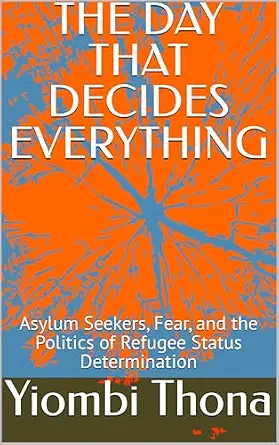
THE DAY THAT DECIDES EVERYTHING: Asylum Seekers, Fear, and the Politics of Refugee Status Determination Yiombi Thona Patrick University of Ottawa, Faculty of LawEvery year, millions of human beings walk into a room, sit before a stranger, and are asked to prove that their fear is real. The outcome of that encounter — often lasting less than an hour — will determine whether they live in safety or are sent back to the danger from which they fled. No appeal to conscience. No second chance. One hearing. One day. A life decided.Yet the system entrusted with this extraordinary power is riddled with structural failures so deep, so normalized, and so consequential that they amount to a form of institutional violence. The Day That Decides Everything is the most comprehensive critical examination of refugee status determination (RSD) ever written, and it is unlike any book on refugee law that has come before it.Drawing on international refugee law, trauma neuroscience, critical legal theory, sociolinguistics, and the author’s own six-year lived experience as an asylum seeker in South Korea — and ultimate vindication before the Administrative Court of Korea — this book dismantles, chapter by chapter, the fiction that RSD is a neutral legal process. It is not. It is a site of power, cultural asymmetry, linguistic violence, and institutional indifference.Organized across five parts and fourteen chapters, the work opens by constructing a rigorous legal and theoretical lexicon, situating RSD within the framework of the 1951 Refugee Convention and examining it through Foucauldian power analysis, structural violence theory, and legal anthropology. Part II breaks open the pre-hearing experience: the weaponization of waiting, the catastrophic intersection of trauma and memory with the demand for coherent narrative, and the design of hearing rooms as spaces of psychological subordination. Part III scrutinizes judicial discretion and inconsistency of outcomes, the epistemology of credibility assessment, and the contested terrain of country condition evidence. Part IV confronts the systemic misreading of non-Western communicative norms as deception, and the structural argument that cultural asymmetry always harms the claimant. Part V addresses the consequences of legal under-representation, the politics of translation, and the violence inflicted on gender-based and LGBTQ+ claimants navigating a system built around a default male, heterosexual archetype.The author’s own case is not mere personal testimony — it is empirical data. When the book demonstrates that adjudicators substitute host-country assumptions for country-of-origin evidence, the author was that claimant. When it argues that averted eye contact — a mark of respect in Congolese professional culture — is misread as deception, the author sat in that chair.The Conclusion charts a path toward a trauma-informed, culturally literate, rights-based model of RSD that fulfills the promise of the 1951 Convention. Three appendices provide comparative recognition rate data, a digest of UNHCR procedural standards, and a model set of hearing guidelines.Essential reading for refugee law scholars, immigration judges, legal practitioners, UNHCR staff, graduate students, and every policymaker with the power to reform a system that decides, every day, who deserves to live without fear.The law was written to protect the persecuted. This book demands that it be made to do so.Studies in Refugee & Asylum Law Law / Human Rights / International Law March 2026
نقد و بررسیها
هنوز بررسیای ثبت نشده است.